Arts at the Exploratorium

The arts are a fundamental method of discovery at the Exploratorium.
We engage artists in every facet of our work and in a multitude of ways to inspire curiosity and further an interdisciplinary approach to seeing and understanding the world. The Exploratorium views art as integral to learning. Inquiry, the learning approach espoused by philosopher and educator John Dewey, animated Frank Oppenheimer’s educational vision for the Exploratorium. For us, the artistic process—much like the scientific process—is a form of investigation vital to learning.
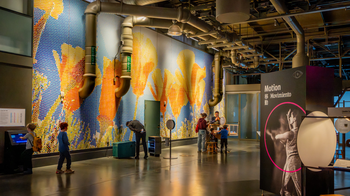
From creating long-lasting exhibits on our museum floor to developing unforgettable performances and programs in our public spaces, the Exploratorium has presented the work of hundreds of artists working at the intersection of art, science, and human perception.
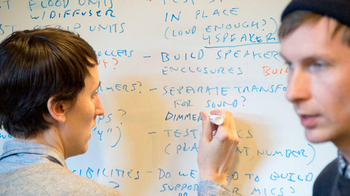
Artists contribute in countless ways to our ongoing research and development, both on and off the museum floor. In partnership with key staff, many of whom are artists themselves, outside artists explore themes such as human cognition and social behavior, physics and perception, ecologies of place, living systems, and making as learning.
History of Art at the Exploratorium
When physicist and educator Frank Oppenheimer founded the Exploratorium, he envisioned a hybrid between a laboratory and a public museum. Since 1969 the Exploratorium has cultivated a unique working environment for artists interested in cross-disciplinary investigations and hybrid approaches.
The Exploratorium’s doors first opened in 1969 with Cybernetic Serendipity, the seminal exhibition of art, science, and technology curated by Jasia Reichardt for the Institute of Contemporary Art in London. In 1974, the creation of an Artist-in-Residence program enabled dialogue and collaboration between artists and other interdisciplinary thinkers such as scientists, engineers, educators, and inventors. By the late 1970s the Exploratorium had established itself as the home for a burgeoning countercultural art scene on the West Coast.
In 2011 the Exploratorium convened an international conference called Art as a Way of Knowing (made possible by a grant from the National Science Foundation) to better understand the role of aesthetic inquiry in public interdisciplinary learning environments. As an outcome of that project, the Exploratorium renewed its commitment to advocate for the importance of art as an essential aspect of learning.
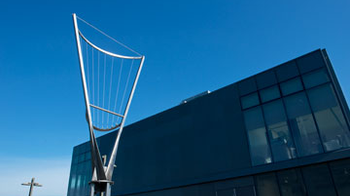
Since moving to Pier 15 in 2013, the Exploratorium has debuted scores of new art projects both inside and outside the building. Expansive outdoor space, state-of-the-art facilities, and wide-ranging themes of investigation has allowed for even greater possibilities for artistic exploration.